How to foster an AML compliance culture for real impact
The abundance of material online has somewhat diluted its impact, making it challenging to convey the tangible benefits of compliance effectively. In the complex world of anti-money laundering (AML), it’s essential to highlight thought leaders who are prepared to question conventional thinking. Building a strong AML compliance culture means focusing on the real-world consequences of financial crime and recognising the vital role the financial sector plays in safeguarding both customers and broader economic stability. Senior executives – from government agencies to banks and tech firms – must act as vocal advocates for practical, actionable solutions, moving beyond superficial influence or content designed only to attract attention.

This may have been a pointed, bold view that stirred some discourse, but it did so because people do care. The real human cost of financial crime is horrific; considered thought leadership can remind us that’s the case, and prove that we need to care enough to make our anti-fincrime defence as powerful as it should be.
Bradley Elliott, CEO RelyComply
The principle of “Adoption, Amplification, Action”
In the often-misunderstood world of compliance, it’s important to highlight thought leaders who are prepared to question conventional approaches. By focusing on the tangible consequences of financial crime and recognising the essential role the financial system plays in protecting customers and wider communities, C-level executives from governments, institutions and technology platforms can take an active role in championing practical, actionable solutions rather than simply seeking visibility. Following these three core principles can help you build a strong and effective AML compliance culture within your organisation.
The principle of “Adoption, Amplification, Action”
It’s easy to throw out passing remarks that stick with some audiences and not others. But a purposeful concept or recommendation will be one that’s heeded elsewhere to solve pain points. This showcases adoption where leaders go above and beyond, delivering astute and well-articulated ideas that resonate so greatly with someone that they assimilate the original approach independently to create measurable results.
Using the RegTech industry as an example, it’s not enough to state the obvious that “automation is important” – automated technologies are too nuanced for that catch-all. Instead, explaining how a global bank with stretched budgets can automate high-risk payment checks to lower their risk exposure is an actionable view for their stakeholders to adopt.
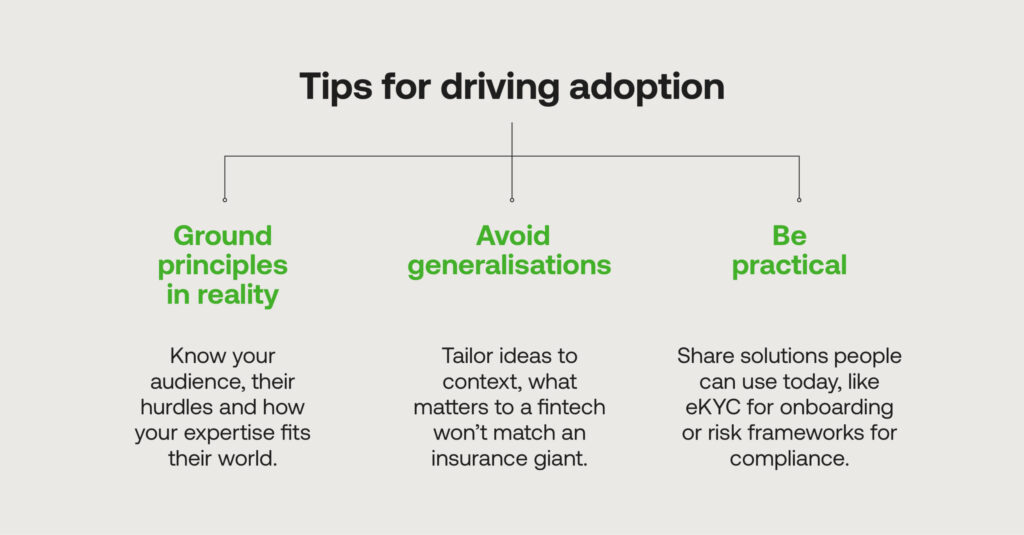
How to drive adoption
- Grounded in principle. The foundation for appealing to audiences is understanding them thoroughly: their hurdles, and how your expertise can be tailored to their lifestyle or livelihood. Telling relevant ‘stories’ that they can see themselves in is helpful to apply fresh (or tricky) concepts to the day-to-day.
- Limit blanket statements. When addressing customers or industry leaders, frame ideas around specific contexts that apply to them, e.g. a small crypto exchange will face different regulatory pressures than an insurance giant.
- Scrap the theory, be practical. Other thought leaders will adopt ideas that are immediately attributable to their world; small-scale solutions target niche uses best, like eKYC for customer onboarding, or building effective risk assessment frameworks.
Amplification: Sitting at the right table
Getting the correct ‘reach’ for your musings is not a numbers game. By operating as a thought leader in a club of expertise, influencing those community members creates actual change. Distinct approaches will relate to them in a different way than any social account follower, and they will be more likely to enhance the amplification of your discussion points within their own forums and extended networks.
They essentially become an advocate to grow your own kudos in the work arena. For instance, you may be quoted by a regulator in a conference panel discussion regarding your point on human-in-the-loop governance; a clear indicator that your message is hitting the right eyes and ears.
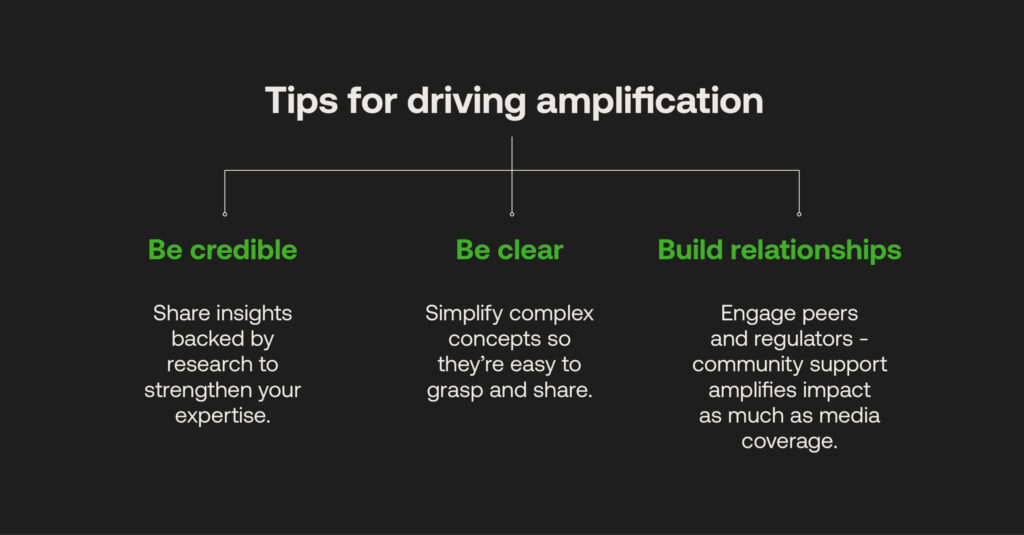
How to drive amplification
- Demonstrate expertise. Content supported by solid research or industry expertise strengthens your authority and makes others more confident in sharing your insights.
- Keep it clear. Complex AML concepts are easier to spread when explained in relatable, digestible terms – making it simple for others to rephrase and share in their own networks.
- Build relationships. Engaging personally with regulators and industry colleagues is just as important as visibility. When the community supports and builds on each other’s insights, the combined influence can rival traditional media coverage. Social or professional groups often offer a powerful platform for discussion, creating a network of thought leaders collectively pushing for meaningful change.
Action: Turning decisions into delivery
That leads to the ultimate test: where your ideas prompt concrete behaviours and executive decisions that improve an outcome. When the results are tangible – perhaps presented back to you in a success story or a simple acknowledgement – that’s validation enough that your influence is being utilised accordingly.
Either in the ‘digital wild’ or in private communications, you may gain engagement with a financial compliance leader that decided to tighten their monitoring capabilities following your shared insight on increased risks – one small step leading to action that has genuine positive effect.
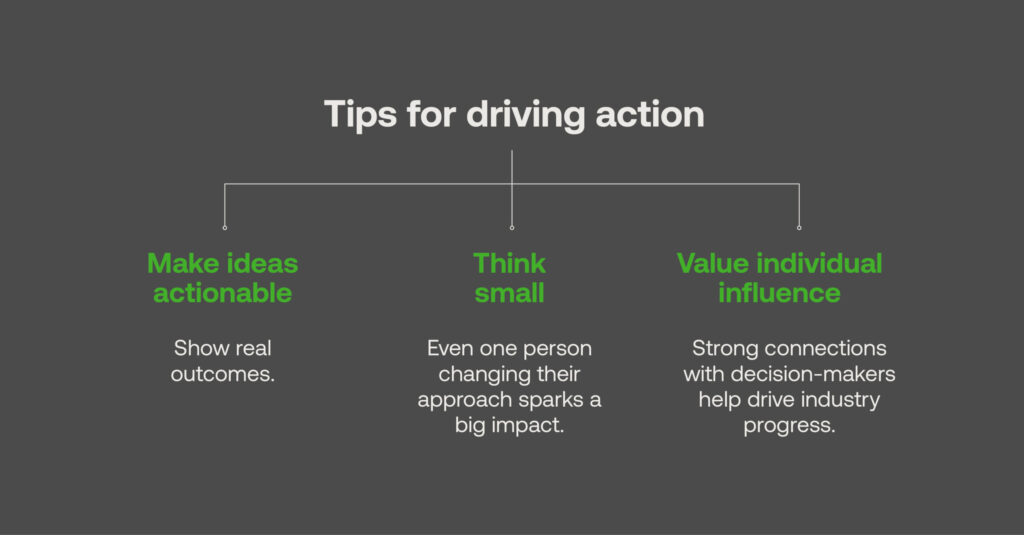
How to drive action
- Connect ideas to ‘doable’ things. Perspectives should always be demonstrated with proven real outcomes in mind. One way can be instructional ‘how tos’, such as “ways to reduce KYC friction” or “how doing this reduces false positives for investigations”.
- Thinking small for big impact. Even influencing a single person to adjust their approach can be transformative – sometimes the smallest insight sparks the largest change.
- Recognise individual contributions. Building lasting relationships with key decision-makers or institutions helps drive meaningful progress across the industry.
Pushing the conversation further
Being a leader means shining a torch on the industry in which you operate, and following this three-point framework can help fundamentally change audience perspectives on real-world issues. It’s all for the benefit of operational ease on one hand, but also to positively impact wider culture – something that compliance screams out for with its crucial role in maintaining our system’s integrity.
We should all be on the mission to converse, collaborate, experiment, better our digital means, and increase our collective wealth of knowledge against those looking to take advantage of the world – turning talk into community-driven action that makes for a better, safer world brick by brick.