What is eKYC? A complete guide to electronic Know Your Customer in the UK

UK financial services have moved towards digital onboarding faster than almost any other market, driven by Open Banking and a generation of digital-first challenger banks and fintechs like Monzo, Starling, and Revolut. Behind that seamless “sign up in minutes” experience is eKYC: the electronic, automated way to verify who a customer is.
In this guide, you will learn what eKYC is, how the eKYC process works, why it matters for UK firms under Financial Conduct Authority (FCA) and Anti-Money Laundering (AML) regulations, and what to look for when evaluating eKYC solutions.
Table of Contents
What is eKYC?
eKYC, or electronic Know Your Customer, is the digital, automated version of the traditional Know Your Customer process. Instead of in-branch visits and paper documents, eKYC uses software to verify a customer’s identity remotely and in real time.
It helps to be clear on the underlying concept first. KYC (Know Your Customer) is the regulated process of confirming a customer’s identity and assessing their financial crime risk. eKYC simply delivers that through digital channels. It sits at two points in the customer lifecycle: customer identification at onboarding, and ongoing monitoring afterwards.
eKYC is relevant across UK-regulated industries: KYC banking, fintech, insurance, crypto, and gambling, all of which fall under FCA supervision and AML obligations.
eKYC vs traditional KYC: what is the difference?
The key difference is speed, cost, and scale: eKYC verifies a customer’s identity digitally in minutes, while traditional KYC relies on manual processes that can take days or weeks. The contrast is most obvious when you compare them directly:
| Traditional KYC | eKYC | |
|---|---|---|
| Speed | Days, sometimes weeks | Minutes |
| Cost | High (manual labour, branch visits) | Lower per check at scale |
| Accuracy | Prone to human error | Consistent, automated checks |
| Customer experience | In-branch visits, paper forms | Fully remote, mobile-first |
| Scalability | Limited by headcount | Scales with demand |
Manual KYC procedures, in-branch visits, posted documents, and slow turnaround create friction that UK consumers increasingly will not tolerate. eKYC enables fully remote onboarding, which became essential during the pandemic and is now simply expected. UK customers who can open a current account on their phone in minutes have little patience for a process that takes a week.
Why does eKYC matter for UK businesses?
eKYC is not just a convenience: it is how firms efficiently meet their compliance KYC obligations.
Those obligations are derived from the FCA and the Money Laundering, Terrorist Financing and Transfer of Funds (Information on the Payer) Regulations 2017 (MLRs), as interpreted through JMLSG (Joint Money Laundering Steering Group) guidance. The Economic Crime and Corporate Transparency Act 2023 has further tightened identity verification requirements, particularly for business customers.
UK firms operating across both UK and EU markets also have to satisfy two regulatory regimes rather than one, which makes consistent, well-documented eKYC even more valuable. And the direction of travel is clear: the UK Digital Identity and Attributes Trust Framework (DIATF) is building a certified ecosystem of digital identity providers that, over time, will make trusted, reusable digital identity a mainstream part of UK onboarding.
How does the eKYC process work?
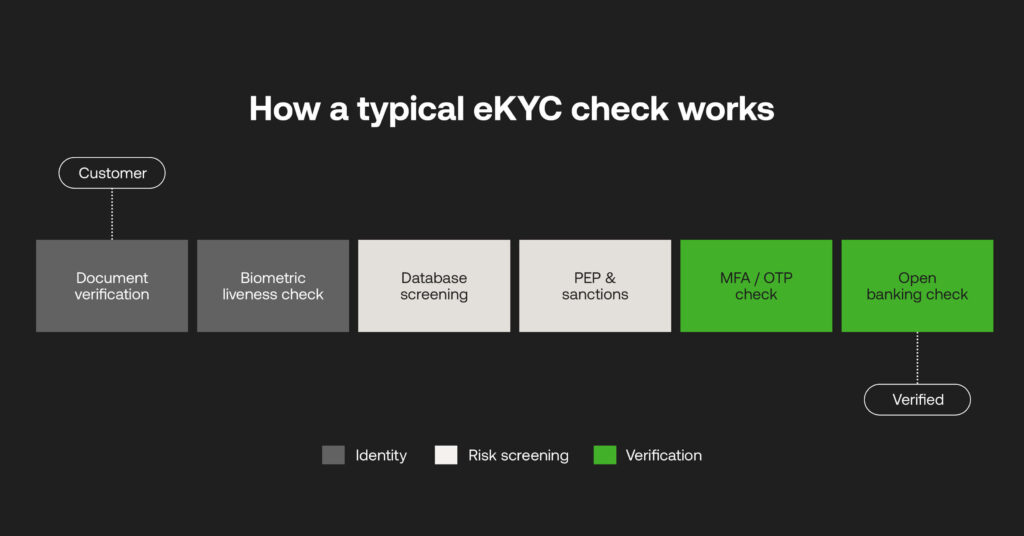
The eKYC process digitises each step of standard KYC procedures. A typical flow combines several of the following:
- Document verification: checking a passport, driving licence, or UK utility bill, often using automated authenticity checks.
- Biometric checks: facial recognition and liveness detection to confirm the person is real and matches their document.
- Database and watchlist checks: screening against UK and international watchlists.
- PEP and sanctions screening: identifying Politically Exposed Persons and sanctioned individuals or entities.
- One-time passwords and multi-factor authentication: verifying control of a phone number or email address.
- Open Banking-based verification: a distinctly UK approach, using a customer’s verified bank data to confirm identity.
Most eKYC solutions combine several of these into a layered approach, so that a weakness in one method is covered by another.
When do regulated firms use eKYC?
eKYC is not limited to new customer onboarding. Regulated UK firms use it across the full customer lifecycle:
- Opening an additional account as an existing customer.
- Upgrading an account, for example, from a personal to a business account.
- Approving higher-risk transactions that require additional identity assurance.
- Reverifying customers following suspicious activity or a triggered risk review.
- Resetting access or updating sensitive account details.
What are the benefits of eKYC for UK companies?
eKYC delivers measurable advantages across speed, cost, compliance, and customer experience:
- Faster onboarding and fewer drop-offs, because customers complete verification in minutes.
- Lower cost per KYC check compared with manual processes, particularly at scale.
- Scalability for growth without a proportional increase in headcount.
- Fewer human errors in the day-to-day work of knowing your customers accurately.
- Stronger support for AML obligations.
- A better audit trail for FCA inspections.
- An improved customer experience that matches the standard set by digital banking.
Case Study: Purple Group
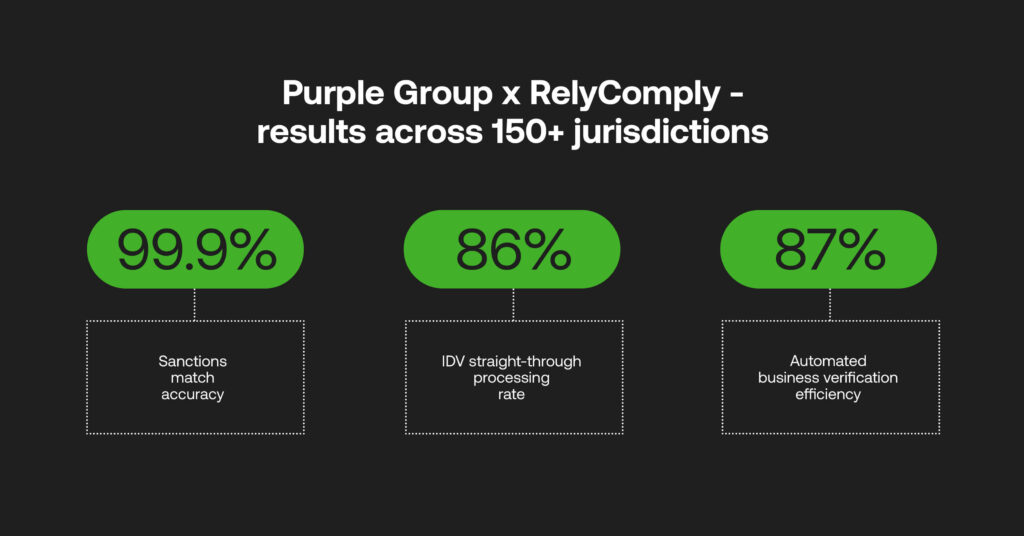
Purple Group, a diversified financial services company serving more than 3 million users across multiple markets, implemented RelyComply’s KYC and identity verification platform to unify customer and business onboarding at scale. The results included a 99.9% sanctions match accuracy rate, an 86% IDV straight-through processing rate, and 87% automated business verification screening efficiency, delivering consistent, audit-ready compliance across more than 150 jurisdictions.
Read full case study
What are the limitations and challenges of eKYC?
eKYC is powerful, but it is not without trade-offs:
- Digital exclusion: some customers, often older or less digitally confident, struggle with app-based verification.
- False positives: automated screening can flag legitimate customers, creating friction and manual review work.
- Data privacy: collecting biometric and identity data carries clear obligations under UK GDPR.
- Evolving guidance: FCA expectations and JMLSG guidance change, and systems must keep pace.
- Sophisticated fraud: deepfakes and synthetic identities are a growing threat to automated verification.
- Vendor lock-in: an all-in-one solution can be hard to migrate away from later.
How do you choose an eKYC solution in the UK?
The right eKYC solution depends on your risk profile, customer base, and growth plans. When evaluating KYC services, UK firms should look for:
- Regulatory fit: FCA-aligned, UK GDPR-ready, and ideally ISO 27001 certified.
- Integration: works with your existing CRM and core banking or processing systems.
- UK data coverage: access to UK-specific sources such as Companies House, the electoral roll, and credit reference agencies.
- Screening flexibility: both real-time and batch screening options.
- Lifecycle coverage: support for ongoing monitoring, not just onboarding checks.
Weigh these factors against your own requirements rather than any single vendor’s pitch.
Simplify customer onboarding with eKYC
eKYC has moved from a nice-to-have to the default for UK KYC services and compliance KYC. It lets firms onboard customers quickly, meet their AML obligations, deliver the digital experience customers now expect, and maintain the audit trail the FCA looks for.
If you want to see eKYC in action, RelyComply helps FCA-regulated UK firms run electronic Know Your Customer at scale. Arrange a demo.
Frequently asked questions about eKYC
Is eKYC mandatory in the UK?
eKYC itself is not mandated by law, but the underlying Know Your Customer process is a legal requirement for most regulated firms under the Money Laundering Regulations 2017. eKYC is simply the digital method of meeting that obligation, and it is now the standard approach across KYC banking, fintech, and other FCA-regulated sectors.
What is the difference between KYC and eKYC?
KYC (Know Your Customer) is the regulated process of verifying a customer’s identity and assessing their financial crime risk. eKYC is the electronic, automated delivery of that same process. The legal obligation is the same; eKYC replaces manual, paper-based KYC procedures with digital verification that is faster, more scalable, and less prone to human error.
Which industries need eKYC in the UK?
Any UK business subject to AML regulation needs to carry out KYC. This includes banks and building societies, fintechs, payment institutions, insurance providers, cryptocurrency firms, and gambling operators. All of these fall under FCA supervision and are required to verify customer identification at onboarding and monitor customers on an ongoing basis.
How long does eKYC take?
A typical eKYC check takes between one and five minutes for a straightforward consumer onboarding case. More complex checks, such as business customer verification or enhanced due diligence for higher-risk individuals, take longer depending on the documents and data sources involved.
Is eKYC compliant with UK GDPR?
eKYC can be fully compliant with UK GDPR, but it requires care. Collecting biometric data and identity documents is a significant data processing activity, and firms must have a lawful basis, retain data only as long as necessary, and implement appropriate security measures. Reputable eKYC solutions are designed with UK GDPR compliance built in, but firms remain responsible for their own data controller obligations.