How life insurance can create opportunities for financial criminals to launder money
The onus on banks to have sound AML compliance frameworks is all too well known. But this does not exclude other institutions from the gaze of regulators. Life insurers – themselves dealing with large-sum premiums – are in the firing line for launderers. Especially so, given their perceived complacent attitude toward mitigating the same risks that other sectors face.
Long-term insurers have for years been classed as accountable institutions under South Africa’s Financial Intelligence Centre Act (FICA), but many have been slow to adapt their monitoring capabilities to match the sophistication of the wrongdoers currently exploiting them – all before their methods become too advanced to play catch-up.
Only once compliance leaders ditch the outdated tag of AML as a periodic obligation can the industry secure a better reputation as a continuous, proactive defence against financial crime that’s been left to multiply.
Insurance’s attraction to launderers
Life insurance occupies a unique lane in financial circles, providing long-term investment vehicles used by customers for advanced financial planning. Such coverage carries the weight of being a social norm – more than, say, a hefty one-off cash deposit – disguising laundering attempts as legitimate policies. And as launderers ‘place’ and ‘integrate’ their dirty funds across expanded timelines to hide their sources and destinations, long-term policy durations make this trail of activity harder to pin down.
There is also an inherent danger that differentiated insurance products can be hybrid instruments. Universal life insurance can be tax-deferred or tied to funds, bonds or equities for instance, granting other channels for illicit cash to be accumulated and flushed easily. Laundering seems an unfortunate consequence of the way that life insurance policies function. What is less agreeable is that many insurers choose to continue their compliance operations as they are, despite the clear AML blind spots.
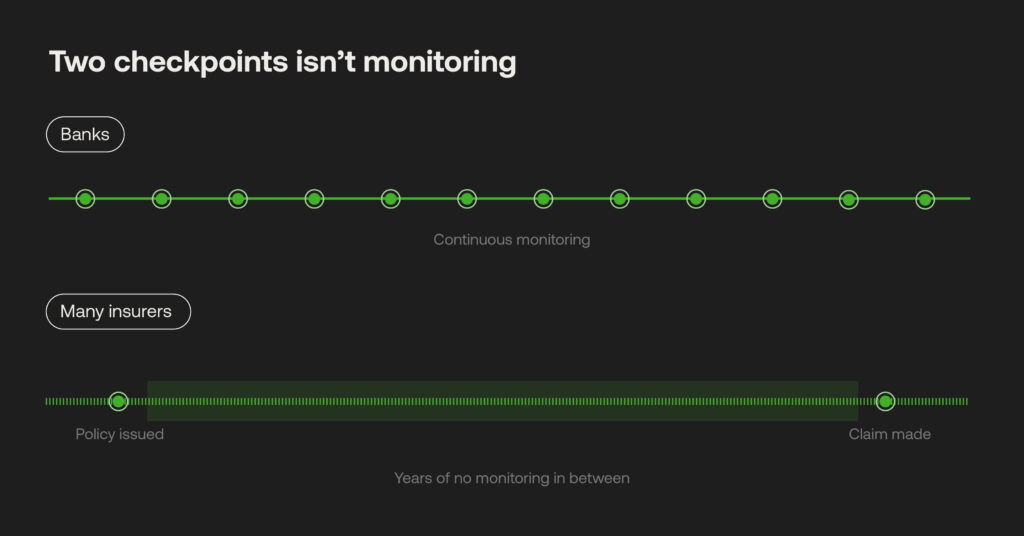
While banks have traditionally invested heavily in onboarding and ongoing AML controls, many insurers have historically focused verification around policy issuance and claims processes. This can leave gaps in continuous monitoring throughout the life of a policy.
Where South African regulations has responded
South Africa’s AML/CFT framework came under intense scrutiny after the country was placed on the Financial Action Task Force’s (FATF) “increased monitoring” greylist in February 2023. Traditional financial institutions were in the line of fire alongside law enforcement, government agencies, police forces, and local regulators.
After 32 months of reform, South Africa formally exited the greylist in October 2025, but the pressure on accountable institutions hasn’t eased. Long-term insurers remain flagged as accountable institutions under FICA, required to exhibit tight AML obligations, overseen by the nation’s financial intelligence unit. The conduct of life insurers is also supervised by the Prudential Authority and the Financial Sector Conduct Authority (FSCA) to protect firms and their customers.
To increasing intensity, the FIC now demands more than just well-documented risk controls proportional to the nature of the insurance industry. Firms have to sufficiently demonstrate how effectively they monitor customer and transactional data to battle financial crime.
With expectations to the same level as the most ‘under the microscope’ financial service providers, insurers’ lax or late CDD protocols must improve to cite initial sources of funds and customers’ intent for coverage, and utilise continuous monitoring to assess ambiguous behaviours across the entire length of a policy.
Common, but uncaught, typologies
Exploiting the longevity of life insurance policies, launderers will stretch timelines and channels between placement, layering, and integration to avoid suspicion among the pooled activities of legitimate policy holders, often via these methods.
Early surrender
Surrendering policies early equals financial penalties, and is therefore not indicative of a rational customer. After holding a policy up to 36 months after paying a large single premium, a launderer will seek a surrender to take the penalty, as the remaining funds paid out to them will be ‘cleaned’ by a regulated firm.
Overpayments on premiums
During transaction monitoring, an insurer’s AML system likely only flags missed payments as suspicious; not overpaid amounts. Criminals use this to their advantage by constantly paying more into a flexible-premium policy for their illicit funds to return clean, reimbursed by an insurer after the overpayment refunds are requested.
Policy loans
A permanent life insurance policy bought with large sums builds up cash value over longer periods. That policyholder can then borrow from the life insurer directly against their cash value. These loans appear legitimate, avoid surrenders or monitoring triggers, and allow funds to be recycled into criminals’ lifecycle, obscured from illicit origins.
Misguided reliance on rules-based AML
What such sector-specific risks show is that generic AML approaches and platforms are inadequate to spot them. Traditional banking monitoring may miss insurance-specific behavioural patterns if it has not been adapted for insurance products.
This criminal adaptation is exceedingly dangerous, as static life insurers cannot possibly evolve fincrime defence at the same rate. If customer risk ratings are applied one-time at KYC to pass audits, their profiles quickly become outdated and invalid.
Any customer’s behaviour can change during long-term policies and could be indicative of crime, with no flexible, automated monitoring mechanisms or CDD triggers to discover threats in real time. Missed payments included, analysts’ risk assessment programmes have to be applied in line with realistic typologies. Over-sensitive alerts for low-risk activity generate high volumes of false positives, and this piles pressure on under-resourced compliance teams.
What makes truly effective life insurance AML
Some good news, however: these criminal patterns are not new, nor impossible to detect or disrupt. The actual difficulty facing even the most knowledgeable firms is how to design an AML platform for bank-level regulatory oversight that is applicable to the life insurance world.
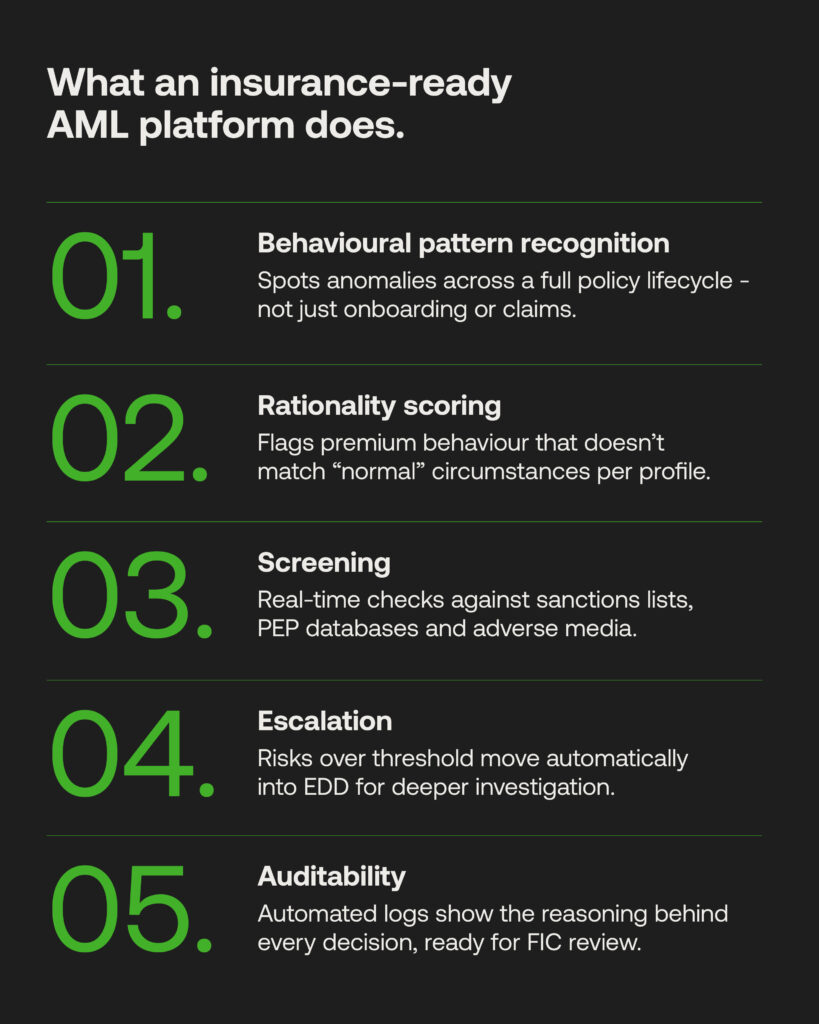
RegTech advances are making this possible, essentially helping insurance firms build centralised data-rich AML platforms attuned to personalised risk, with automated screening and monitoring from KYC through CDD, enhanced due diligence (EDD) and reporting:
- Behavioural pattern recognition: AI models trained on historical data can spot anomalous laundering typologies within transactions across a full policy lifecycle (and not just at onboarding or claims stages).
- Rationality scoring: creating risk-based triggers based on predictable, sense-driven premium behaviours per customer profile, including ‘normal’ circumstances for lapses and loans.
- Screening methods: integrations with current, trusted sources help insurers discover suspicious customers in real-time across the terms of a policy, on sanctions lists, PEP databases, and through reputable adverse media outlets.
- Escalation: detected risks that exceed thresholds (indicative of laundering activity) can automatically be entered into EDD for thorough background checks, streamlining analysts’ investigations into high-risk behaviour.
- Auditability: where FIC supervision expects explainable data-backed insight into their reporting of suspicious activity, an automated system creates audit logs to transparently show a compliance team’s strategic thinking, decision-making, and methodology.
AML platforms: maintaining insurance firm’s trust
Insurance firms are heavily liable for systemic AML issues, and up to this point have been slow to address them. Their vulnerabilities are not theoretical by any means – the FATF, the FIC and FSCA have placed a sustained onus on all institutions to keep laundering at bay, and avoid the reputational damage resulting from South Africa’s greylisting.
With all levels of a firm being accountable, robust AML monitoring is a clear trust signal to these regulators, as well as to the institutional investors, clients, and correspondent banks and fund managers that work with them.
Investing in an effective AML platform also instills a proactive framework for managing risk, applied to the niche products involved in life insurance. It provides a competitive advantage as a flexible solution to evolve AML measures as time and customer data volumes progress.
As end-to-end monitoring capabilities already exist to identify known typologies, those that adapt AML for the life insurance industry – and do not simply follow banks’ AML setups – will get ahead, even as South Africa moves into its next FATF Mutual Evaluation cycle and launderers continue to treat the insurance sector as an easy vehicle for their craft.
To discover more about how life insurance AML can be tailored to the demands of FICA’s compliance expectations, feel free to contact the team at RelyComply.