Why adverse media screening remains a misunderstood AML afterthought

While many financial institutions (FIs) may run adverse media screening, it is deemed a compulsory requirement rather than being a thoughtful move. With that, the power and importance of adverse media has been disregarded in the end-to-end AML process.
Elsewhere, today’s alerts are so voluminous, and so often pure noise, that alert fatigue has become a normality. This forces adverse media sources’ validity to get questioned – to then be reviewed manually, inconsistently, or ignored completely – whereby false positives mount up and block the genuine signals of potential crime.
But as an imperative background check for every customer, ignoring adverse media KYC has dire effects for investigations from that inception point onwards.
The narrative around adverse media practice should be very different. It is a targeted tool for spotting real-time threats diligently, and for utilising public-source financial crime intelligence properly – when firms know how, and through guided RegTech partnerships.
How adverse media gets confused
The availability of public information is unprecedented, in the very palms of our hands. Beyond bombardment on personal feeds though, the number of ‘potentially’ risky alerts for FIs around a payment or customer profile is far more sheer.
Adverse media screening involves identifying any negative information from public sources. This means that ambiguous blog posts, social media posts, and Reddit threads could be granted the same degree of authority as quantitative, audited customer data.
At the same time, sanctions data is far more structured against official lists, and politically exposed persons (PEPs) – public executives or senior government workers carrying potential bribery or state capture risks – are more obvious high-risk priorities for enhanced due diligence (EDD).
Every adverse media source instead requires manual judgement to determine its relevance and any implications; a lengthy task, albeit an unavoidable one, as the first public sign of fraud and corruption allegations, or links to organised crime networks.
Often, adverse media is viewed as a historical document when it should instead be deemed as a forward-facing warning flag needed for accurate monitoring and reporting. Used in conjunction with verified risk data, adverse media screening is a dynamic risk indicator, even before sanctions or PEP checks need to be considered.
Cases for underused adverse media in financial services
Under today’s regulatory burdens, firms need to understand customer risk wholly. Only a 360° view of every entity can truly help analysts unearth past suspicious behaviours, better predict their common movements, and tie together any hidden networks.
Despite the human capacity to complete this task being limited, there remains an overreliance on manually sifting through adverse media alerts. Truly, it is impossible for a team of select analysts to understand or justify every news piece from every outlet in any jurisdiction in any language.
This is indicative of a wider problem that, despite KYC adverse media screening being in place at many institutions, their systems are not cut out to conduct real-time and continuous monitoring and alerts, or to segment official news outlets, regulatory updates, or judiciary and governmental records from extraneous information.
In fact, online searches can produce a whopping 90% of false positives, where poor AML frameworks let these problems persist:
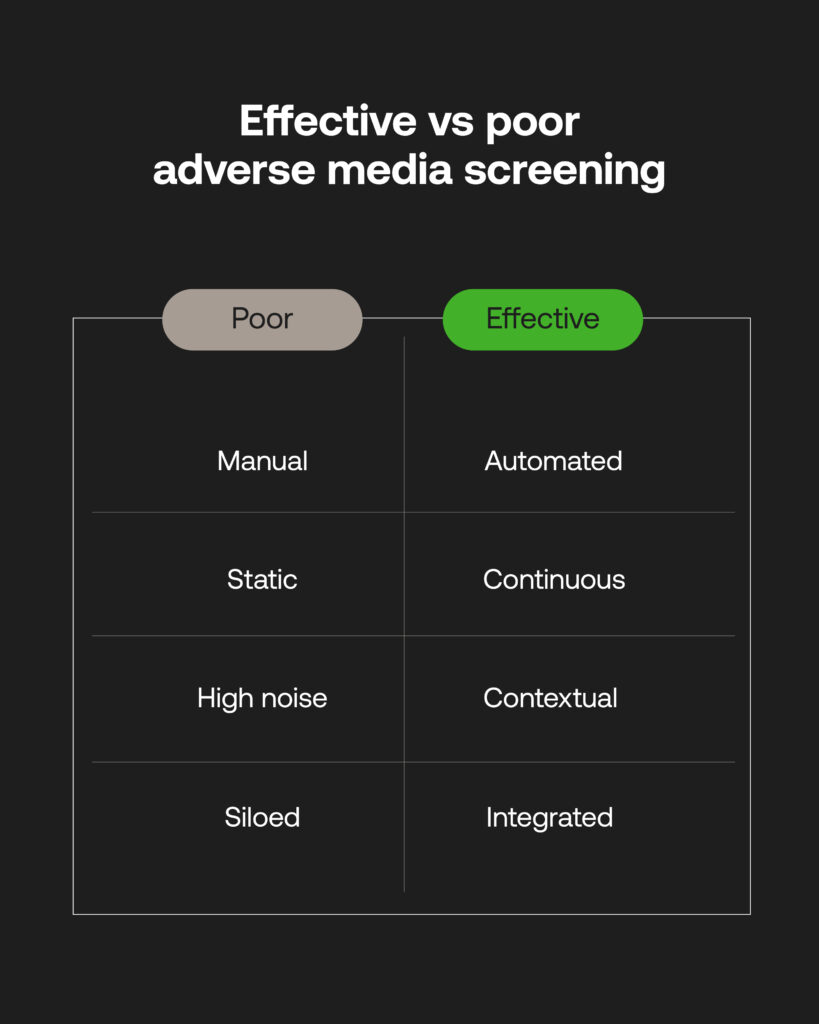
- Lack of contextual risk scoring: Treating every adverse media hit as equal in risk cannot differentiate minor civil issues from egregious financial crime allegations. This gets convoluted further without any mechanism to tie alerts to user-set customer risk ratings.
- Excessive noise: too much screenable media can limit the accurate use of risk management protocols. Allowing excessive low-risk alerts to pass through poor AML configurations increases false positive rates, and desensitisation to serious warnings.
- Poor integrations: KYC adverse media relies on reputable data being ingested into the onboarding decision logic where, from then on, current news can update customer profiles constantly using dynamic risk scoring, rather than adverse media data being siloed from the overall AML process.
Making adverse media proactive risk intelligence
Adverse media’s reputation within the AML compliance process has to change, as it is clearly the earliest possible trigger for investigations into a near-exhaustive list of financial crime wrongdoing. A well-deployed adverse media strategy stays alert to daily news shifts, and stands proactive in the face of red warnings for compliance teams.
As part of primary KYC checks, adverse media feeds directly into dynamic client risk scoring from the very start – adjusting thresholds in real time as new information surfaces, rather than locking a customer into a static risk category at onboarding. This ensures that behavioural anomalies or emerging criminal typologies in later transaction monitoring stages get capitalised on. And by granting greater onus to alerts worth the time – backed by documented rationale for analysts to make better decisions – EDD acts as a crucial investigative tool unblighted by high false positive rates.
Conducting adverse media screening around-the-clock pulls fragmented news sources into an intelligent risk management system, each becoming important puzzle pieces to help picture individual risk profiles. RegTech platforms that specialise in end-to-end AML compliance can automate this screening stage throughout every client’s lifecycle, onboarding legitimate customers in spite of swathes of criminal activity and false information that can usually slow this process.
On the institution’s side, this signifies operational soundness being attributed across a customer’s experience and creates trustworthy relationships.
A practical adverse media screening framework
Even though adverse media is a complex categorisation problem, RegTech partnerships can integrate trusted sources in line with historical business data and customer profiles.
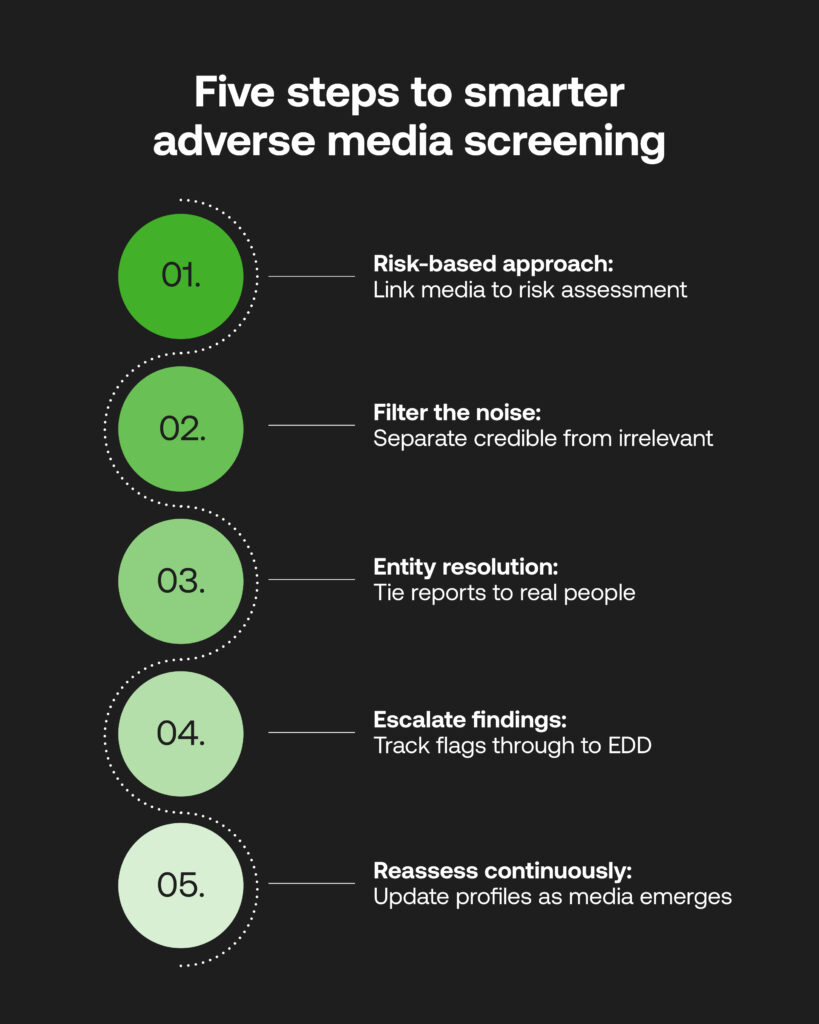
That way, adverse media alerts become a structural pillar for continuous KYC and consistent reporting when deployed through a guided step-by-step process, as follows:
- Take a risk-based AML approach: embedding adverse media checks relies on linking sources to thorough risk assessment strategies, to unveil high-risk information fast.
- Implement filtering: distinguish credible sources from noisy alerts by categorising data indicative of financial crime typologies.
- Conduct entity resolution: connect any suspicious reports to specific individuals or businesses to create unambiguous, contextualised information for future EDD and audits.
- Correlate findings with escalations: track initially flagged activity through automated triage, EDD, and reporting to identify the cause-and-effect of adverse media detection on investigation efforts.
- Reassess clients: implement a workflow that dynamically updates customers’ KYC/KYB risk profiles whenever new pertinent media emerges.
RegTech exists to streamline risk operations and AML frameworks; to reduce false alarms that distract from meaningful investigations, where poorly managed adverse media volumes have long overburdened compliance teams with unsustainable workloads. But times are different, and adverse media screening is a powerful indicator of financial crime risk rather than merely a secondary layer of security.
Access to credible sources has always been there. It just takes better AML configurations, contextual scoring, and real-time alerting capabilities to ensure relevant news reaches the top of the pack, and therefore becomes the ammunition FIs need to make their adverse media regulatory requirements an advantageous reality.