How economic shifts increase financial crime risk UK firms face, and the necessary AML compliance

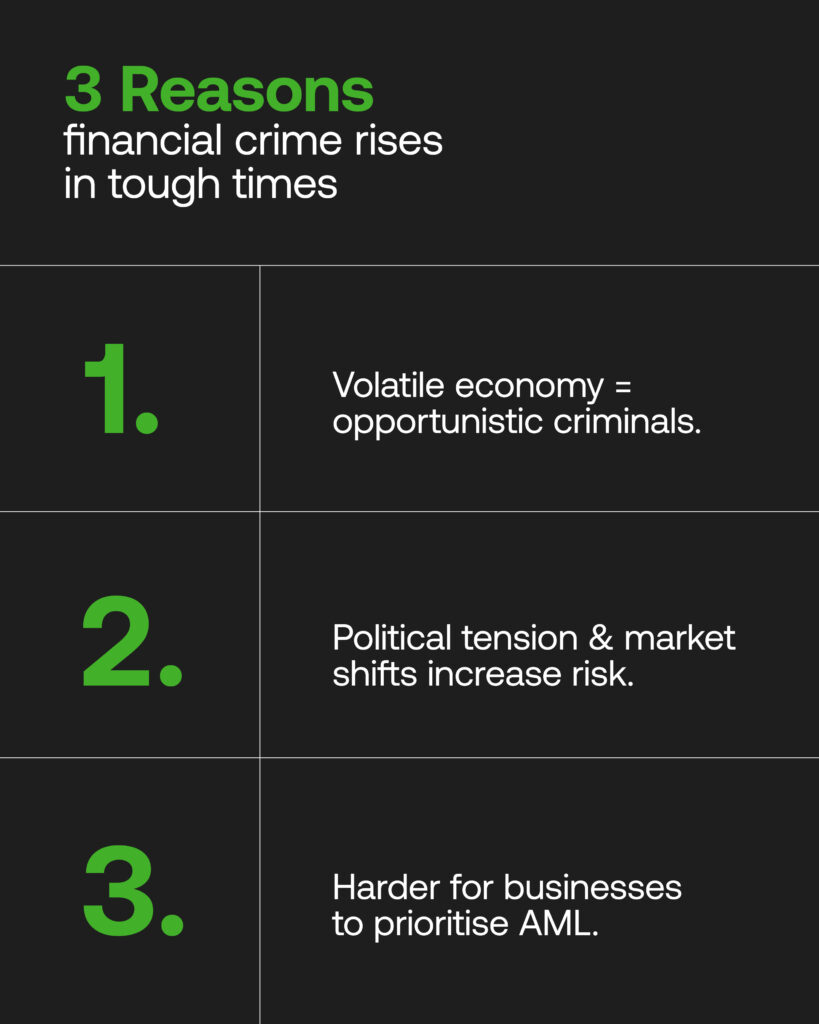
In times of economic uncertainty, the financial crime risk UK firms face can pass by as yet another challenge placed on the back burner. The macroeconomic climate changes at the drop of a hat in an increasingly connected world – one experiencing multi-regional political tension – and any hesitance from investors and consumers will have a hit on the firms and fintechs that are also assigned with protecting them from fraud, scams and other digital threats in the underbelly of the financial system.
Harder still, the regulatory scrutiny UK financial services face often constricts their ability to prioritise AML and cut out these opportunistic criminals that take advantage of economic markets in upheaval. However, there’s a way for anti-fincrime compliance to be enacted in line with business growth; it takes a positive attitude toward immediate RegTech investment that meets heightened expectations, and is proactive to the risks caused by enduring economic headwinds.
Financial crime risk UK institutions navigate amid economic volatility
The UK has been a market in flux as of late. In late 2025, the Building Societies Association (BSA) noted a weak GDP growth rate amid changing interest rates – where the neutral rate is estimated around 3%, “neither stimulating nor restricting the economy” according to Goldman Sachs, who also link increases in national insurance contributions to a stifled labour market.
This may seem to have an indirect relationship to UK AML regulations, but regulatory clampdowns from the Financial Conduct Authority (FCA) and National Crime Agency (NCA) are warranted. Tougher economic conditions trigger greater unemployment or more drastic measures from businesses to grow at all costs. If individuals and organisations start flocking to unregulated partnerships and seek alternative income streams, they play straight into the hands of fraudsters and wider organised groups driving UK financial crime trends such as investment and romance scams, or cybercrime.
Macro trends impacting AML risk profiles
There are also wider compliance implications the UK faces as a result of the economic risk, as highlighted by the BSA:
- Inflation pressures: Wage growth has moderated lately while household disposable income has decreased driven by taxes on income and wealth. Monetary stress puts consumers at greater risk of being defrauded by emotion-targeted scams – activity which may also bypass compliance functions that have siloed AML and fraud teams.
- Increasing debt: With the annual growth rate of credit card lending at its highest since 2024 (12.1%) comes higher leverage for criminals to obscure their laundered proceeds, making the ability to decipher suspicious transactions from legitimate ones more complex.
- Cautious saving habits: An elevated saving ratio may be indicative in households’ spending habits, which calls for adaptive risk solving that can update risk profiles according to dynamic customer behaviours.
Together, these pressures reshape the financial crime risk UK institutions must continuously reassess as economic conditions evolve.
Other UK regulatory expectations 2026
Every factor here increases the financial crime risk UK businesses must manage, placing greater pressure on those on the frontline to upskill their compliance departments. Facing sophisticated and more voluminous criminal methodologies is a damaging side effect of a volatile market, which can be addressed only from anticipatory AML compliance functions driven by analysts and their increasingly necessary RegTech platforms.
This is tricky across the vastly diversified financial ecosystem offering niche products and dealing with new payment rails, digitalised capabilities, and therefore regulation. Instilling faultless AML is placing more and more accountable institutions under scrutiny, including legal professionals and accountants.
However, as part of the Economic Crime Plan 2, the UK government is ensuring appropriate action is to be taken against firms failing their obligations, becoming a public and private system-wide attempt to bolster AML/counter terrorist financing measures across the board, supervised by the FCA which will solely govern AML responsibilities from some professional body supervisors. This comes as a result of significant vulnerability in the professional services sector, identified by global watchdog the Financial Action Task Force (FATF).
Similar activity is occurring in the United States, including FinCEN’s move to define investment advisers as financial institutions under the Bank Secrecy Act, and the UK faces additional AML frameworks in other markets where its business operate, including the EU’s 6AMLD. While these regional rules differ, the appetite to upgrade to risk-based AML systems through RegTech is growing; after all, every institution faces data privacy laws, a rise in cross-border flows to keep the macroeconomy afloat, and burgeoning transparency regulations for digital assets (such as FATF’s Travel Rule) to strengthen the globe’s fight against criminals.
RegTech’s vital role for an AML governance framework
Traditional legacy systems built for rule-based monitoring are no longer fit for modern AML frameworks, particularly given the heightened financial crime risk UK institutions now face. Operational inefficiencies, excessive false positives and disconnected datasets leave compliance teams reactive rather than strategic.Without a shift to RegTech, it is tough to stay ahead now that systems are expected to accommodate multi-jurisdictional governance, and ultimately enable real-time reporting to relevant authorities – all using AI frameworks also experiencing their own legislative battles.
In which case, strategic partnerships offer a natural progression toward solutions that can face today’s challenges, and those still to come. Robust AI models that enable accurate detection in RegTech platforms are integral for reducing fraud and AML risk, but with increasing governance and expertise can stand a business in good stead to scale, and not hindered by regulatory reporting requirements amid economic turmoil:
Automated know your customer processes
Periodic KYC reviews and the static collection of onboarding documents such as passports, government records, or work permits can mean risk ratings go unchecked for years. Now AI in AML compliance ensures profiles can evolve in real-time when new relationships or transactions are identified by integrated watchlists and data sources.
Real-time AML monitoring and screening
Using user-set risk thresholds, supervised AI models can surface suspicious activity from vast datasets, and in line with ever-changing regulatory market requirements. Even with increased customer data, transaction volumes and shifts in spending behaviour, elastic AML infrastructure is crucial to grow capabilities without being overwhelmed.
Accurate fraud detection
AI’s pattern recognition capabilities ensure that, even for digital assets, new payment rails, and cross-border activity, signs of fraudulent activity are raised immediately to differentiate any legitimate fund flows that fuel the formal economy.
Embedded end-to-end compliance workflows
RegTech platform partnership can enhance the efficiency of existing systems, integrating highly with existing data and automate the auditing of transaction screening and monitoring tasks for SAR reporting. AI is also able to analyse historically filed SARs to identify common typologies and reduce duplicated reports, speeding up the route to detect illicit activity among economic downturns that may lead to prosecution.
Regulatory preparedness checklist for 2026
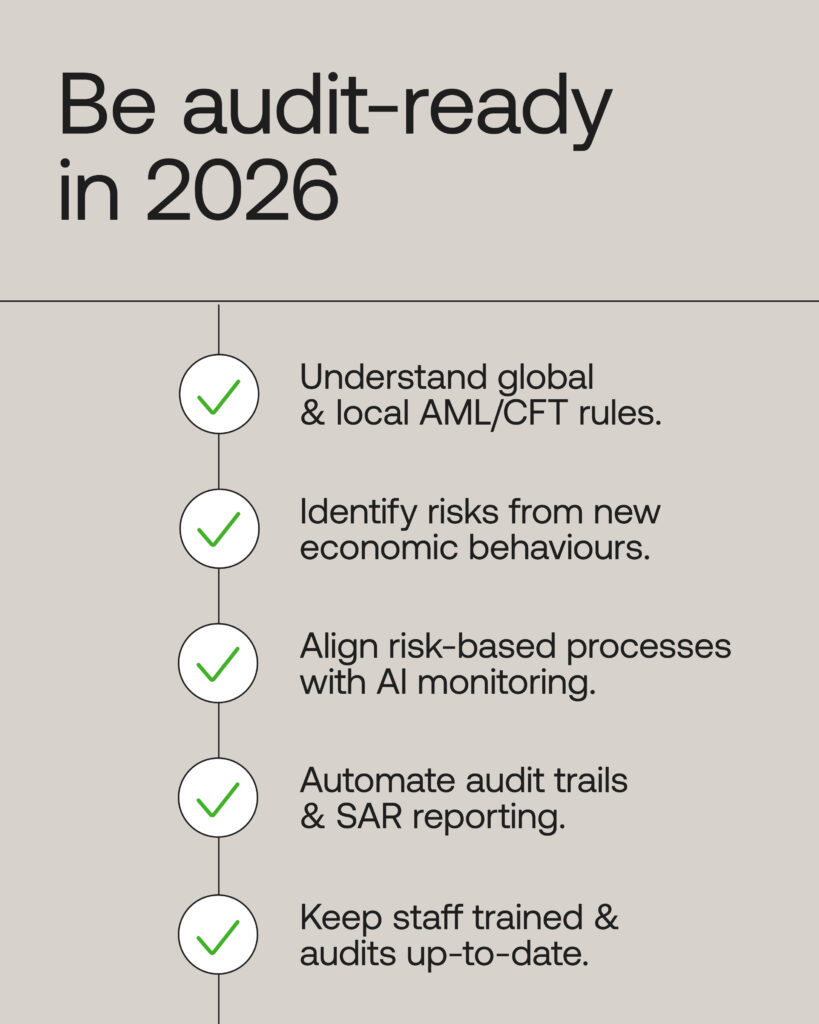
Accountable institutions’ compliance functions can contribute to stamping out the proceeds, instruments and perpetrators of financial crime, whatever their typology and wherever they originate. RegTech is making it easier to determine their AML audit readiness, through a practical, collaborative process that prepares a firm’s people and platforms, including:
- Understanding pertinent reporting obligations under expanded global and local AML/CFT rules.
- Identifying industry-specific risk against new economic behaviours for KYC, such as card lending and debt, shifts toward cryptocurrency consumption etc.
- Aligning risk-based processes to AI-driven monitoring tools.
- Automating the tracking of audit trails and SAR filing to speed up reporting obligations to the NCA.
- Keeping the entire institutions’ workforce aligned on AML compliance shifts, AI usage, data privacy governance, digital asset guidance and other technological change with frequent staff training and external audits on AML systems.
The competitive advantage of risk resilience
Under increasing financial crime risk UK firms face, AML focus must never slip as economic uncertainty grows, granting launderers and other exploitative factions new avenues. It’s no use to be reactive to the threat, where RegTech investment ensures that industry-wide accountable institutions in the UK have well-established compliance measures before regulatory scrutiny expands its scope – an inevitability due to dynamic shifts in the macroeconomy and a transformative digital world.
Stripping away operational headaches makes the efficiency of individual businesses all the more streamlined, with a dramatic effect on the financial market. When they can continue safely bringing new products to market and consumer trust grows, the system can be restored to health, cross-collaborative partnerships bolstered, and criminals kept out. The UK is long-established as an economic power, and heeding UK AML regulations through RegTech can help it maintain momentum for the uncertain digitalised journey ahead.