How trade-based money laundering in insurance is a rising financial crime risk

Trade-based money laundering (TBML) is one of the most durable and hardest-to-detect methods of exploiting the financial services industry. Trade credit insurance businesses have links to TBML, yet many keep their distance from it.
It is through no fault of their own: global anti-money laundering (AML) literature has rarely addressed this connection.
Beyond banks, insurers’ accountability is questioned under the Financial Intelligence Centre Act (FICA) in South Africa, particularly in trade-based business, where TBML can be linked to drugs, arms, tobacco and wildlife trafficking.
This traditional “fincrime silence” presents a blind spot for trade credit insurers. Recognising the risk today can prepare businesses at a time when undetected fraud instances are estimated to be ten times that of detected cases.
Why trade-based money laundering is hard to detect
TBML typologies, while well known, manage to remain among the hardest laundering methods to detect. This likely reflects the scale of international trade, worth US$34.89 trillion in goods and commercial services in 2025, and the fact that value moves through goods as well as payments.
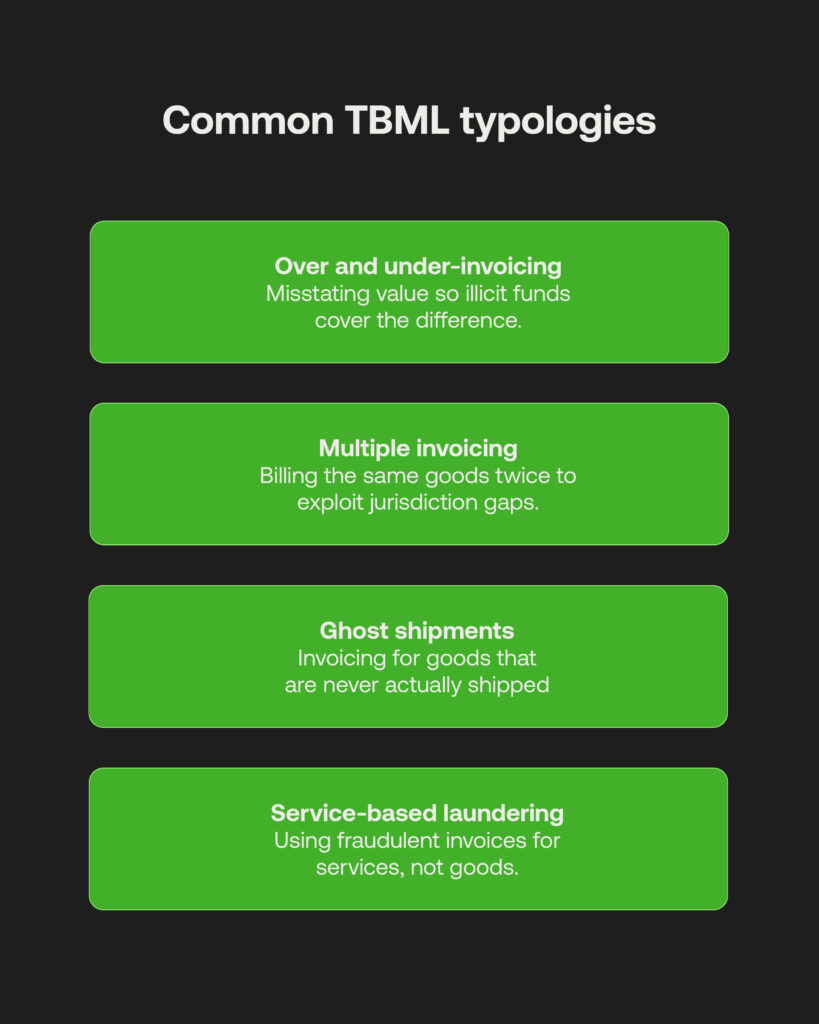
TBML involves basic and luxury goods, invoice manipulation, shell companies, and complex or extended global trade routes. Over- and under-invoicing are key tools: misrepresenting the value of any item or service, where illicit funds make up the price difference, moving dirty money as apparently legitimate trade. This requires collusion between importer and exporter.
Other methods include multiple invoicing for the same goods to exploit jurisdictional gaps, and making ‘ghost shipments’ of falsely claimed items. The UK’s National Risk Assessment 2025 extends the same risk to trade in services, where the value or description of a service can easily be manipulated. The Financial Action Task Force (FATF) and the Egmont Group also identify goods with wide pricing margins and supply chains moving lower-value goods as common risks.
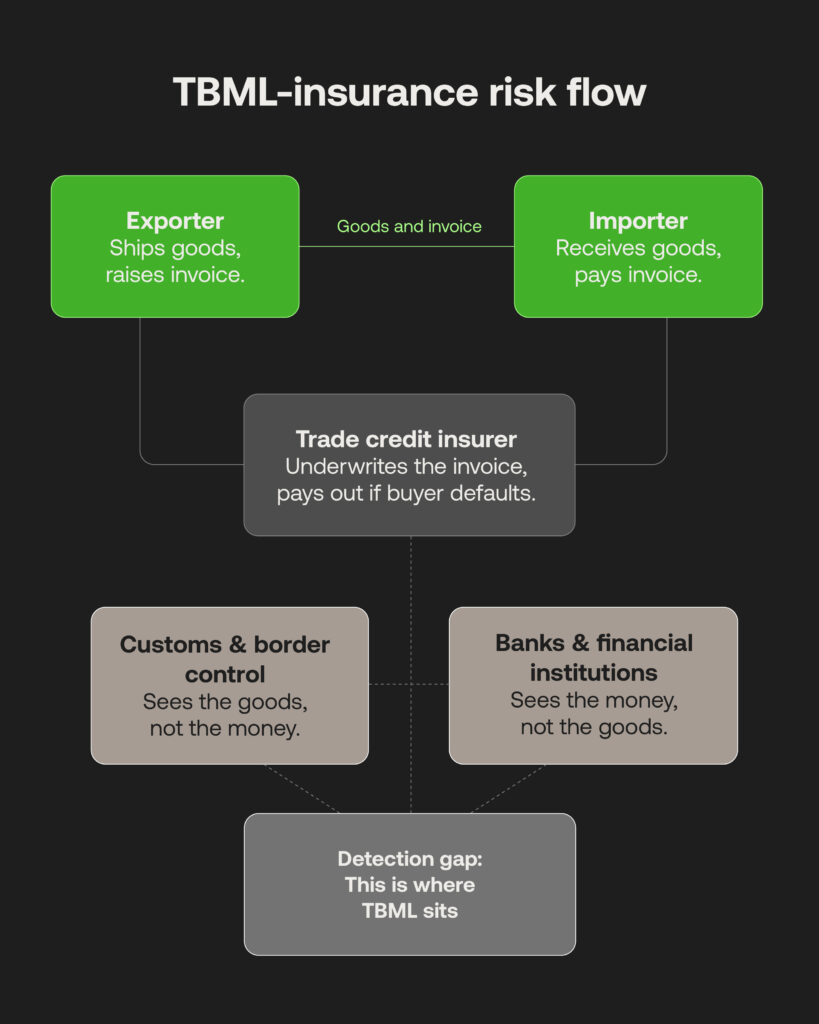
Detection is difficult for financial institutions, which see the transaction but never the goods. Customs and border control see the goods, and their remit covers contraband and tariffs.
The gap this creates is where TBML sits.
How trade credit insurance is exposed to TBML
Trade credit insurers sit in the flow of the transactions themselves, so they face the same risks posed by TBML operatives.
Trade credit insurance already has to assess credit risk before a policy is written, protecting manufacturers, suppliers and traders from buyers who are likely to pay late or, in more extreme cases, go bankrupt or insolvent. A policy will then pay a percentage of outstanding invoice debt.
The International Credit Insurance & Surety Association (ICISA) treats the practice as fundamental: without it, trade would rely on prepaid or cash-based transactions.
It also exists to monitor payment and buyer behaviours. Typically, an insurer will assess a supplier’s needs to write a policy priced to its risk, including cover for particularly high-risk buyers.
This exposes them to TBML: they may underwrite risk-based policies and insure invoices that criminal networks use to move illicit funds.
Where trade credit insurers’ AML controls fall short
Assessing credit risk is the core of this type of cover, and due diligence mostly ends once the insurer knows whether a counterparty can pay. The legitimacy of the buyer’s transactions goes untested.
Missed payment is the primary concern, since it triggers the guarantee. Yet the obligation to monitor a customer’s solvency is continuous, which mirrors perpetual know your customer (pKYC) checks in modern AML structures.
Therefore, while some of the principles for identifying financial crime risk exist in trade insurers’ operations, the tools to act on them are missing, because they are wrongly assumed to be banks’ business alone:
- Awareness of TBML typologies: risk assessment controls at insurers may not be able to take into account suspicious transactional activity employed in invoice-related trade crime.
- Trade flow monitoring: user-set, risk-based thresholds calibrate a monitoring system to an insurer’s own exposure and flag high-risk activity in real time, so the parties and payments involved can be investigated.
- Beneficial ownership: TBML operates through shell companies, complex trade routes, different regions and connected crime networks. Detecting the major stakeholders and runners of such operations requires stringent checks into business structures and sanctioned watchlists.
What FATF’s TBML red flags mean for trade credit insurers
The gap reflects an increasingly sophisticated trade market. It also explains why FATF treats trade finance as a channel for criminal funds, which draws trade credit insurers into the picture.
Trade credit insurers’ AML obligations are less clearly defined. Awareness of TBML’s link to the industry helps insurers mitigate potential threats and prepare for closer regulatory scrutiny.
FATF and the Egmont Group’s Trade-based money laundering: risk indicators (2021) sets out the common TBML red flags in global trade and transactions. Having some sense of complex dealings is fundamental to setting up an advanced AML structure.
Then, trade credit insurers can establish continuous due diligence and monitoring platforms that also take into account suspicious trade finance activity, including:
- KYC: as a first step, insurers should verify a policyholder’s identity, role and agreements made with buyers, whose identities, partnerships, wealth sources and business structures are also crucial, then reassessed whenever their risk profiles change.
- Centralised teams: insurance teams should bring together AML and fraud compliance professionals to create a cohesive unit set on detecting, investigating and reporting TBML risks.
- Adopting automated technology: an end-to-end solution can bring together identity verification tools, dynamic risk scoring, and controls for enhanced due diligence for buyers considered high-risk (thereby lowering arbitrary investigations and false positives).
A thorough risk assessment process is as integral to trade-based insurance as it is to any financial institution currently under the watchful eye of regulatory supervision. Regulatory technology (RegTech) partners can help insurers adopt sector-specific tools ahead of regulation.
Trade credit insurance AML: next steps for South African insurers
South Africa’s insurers need to take part in financial crime detection alongside credit risk. Regulatory demands are shifting fast, and upskilling teams now avoids having to revise AML frameworks too late.
Asking whether a potential buyer could pose a financial crime risk has to happen now, while that risk is growing. It protects policyholders and helps close the gap that trade-based money laundering exploits.
To see how risk-based KYB, monitoring and reporting work for insurers, arrange a demo.