AML accountability in insurance: when non-compliance roles become the unknowing MLRO
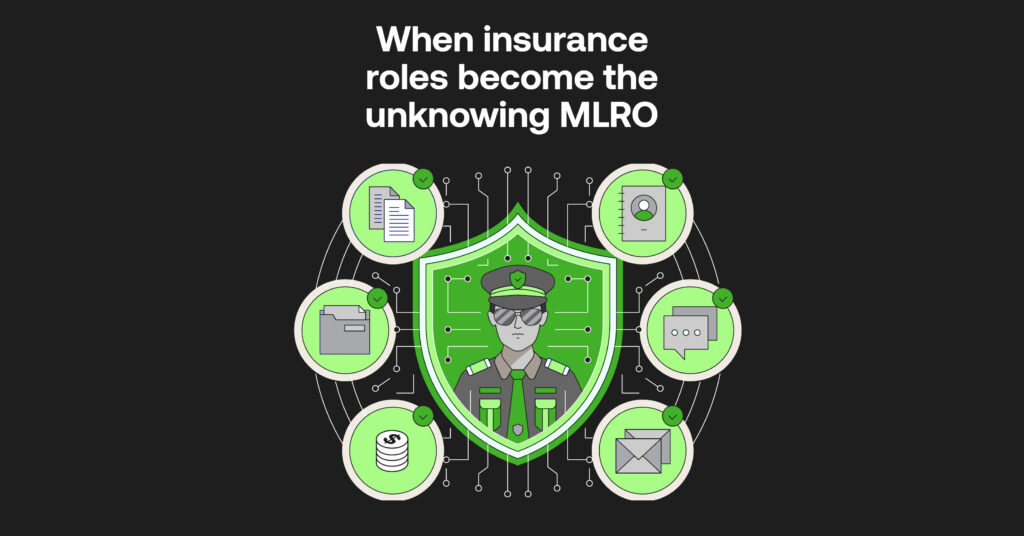
AML accountability in insurance now extends beyond the compliance team: anti-money laundering (AML) duties reach underwriters, product managers, distribution leads and other insurance professionals.
Underwriters, product managers, distribution leads and other insurance professionals are increasingly expected to understand how their day-to-day decisions can expose a business to money laundering and financial crime risk.
This creates a new challenge for professionals who entered insurance to specialise in underwriting, product development or distribution, with AML compliance outside their original remit. As their careers progress and responsibilities grow, AML obligations can unexpectedly become part of the job.
So, what happens when compliance expertise gets thrown into the mix? More than ever, underwriting and distribution leads are finding AML obligations on their plates, with their own risk controls contributing directly to an insurer’s wider compliance culture.
If this sounds familiar, it reflects the AML accountability requirements outlined in the Financial Intelligence Centre Act (FICA). These obligations help strengthen South Africa’s approach to identifying and managing financial crime risk – responsibilities that have come into even sharper focus following the country’s FATF greylisting in 2023 and subsequent removal in October 2025.
How do insurers find themselves exposed?
As with any organisation, an insurance firm’s full potential is greater than the sum of its parts. A connected workforce is more diligent, and widespread AML accountability aims for a more standardised approach to business-wide compliance.
The trouble, though, is that regulatory scrutiny is complex, and reactive to swiftly changing financial crime. Compliance works as an active deterrent against fraudsters and launderers, who increasingly target the day-to-day work of non-compliance professionals:
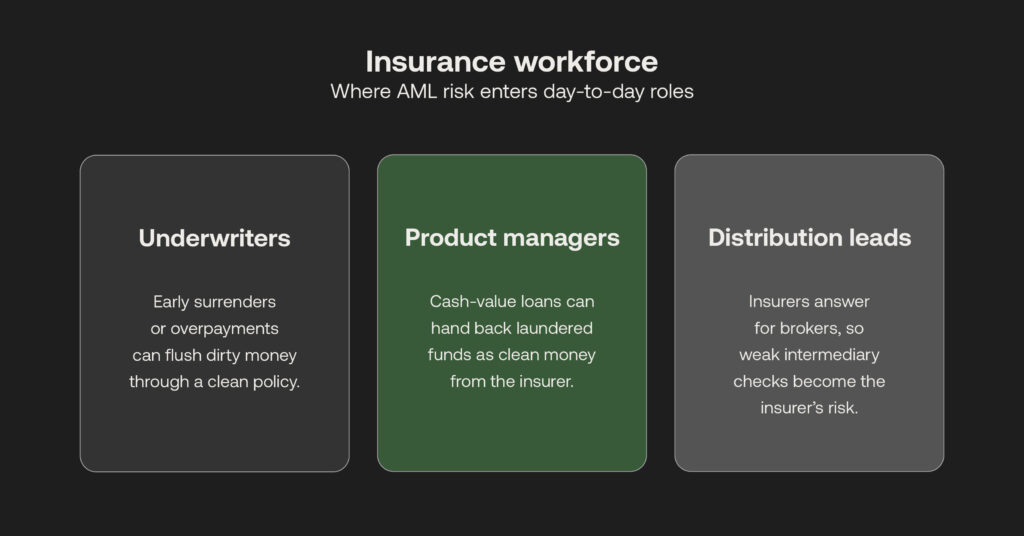
Senior underwriters
Set with the task of vetting potential policyholders’ level of risk, an underwriter is intrinsically involved in an AML framework, requiring a thorough understanding of sources of wealth and linked relationships for every potential customer.
Anomalous or ambiguous details may be indicative of those who take advantage of long-term single-premium products. Launderers are known to opt for early surrenders or overpay to flush illicit funds, for instance.
Product managers
Designers and approvers of a flexible-premium product act in the best interest of clients – offering surrender terms, or policy loans against a cash value pot – but these are open to misuse. Borrowed funds straight from an insurer can be essentially ‘cleaned’ versions of dirty cash. It is becoming an expectation to account for these dangers at the design stage, rather than through retrospective remediation, where it is too late.
Distribution leads and intermediaries
Universal life insurance can be tied to fund management, opening up AML risk within broker or intermediary relationships. As FICA makes clear, accountable institutions are ultimately responsible for the conduct of third parties working on their behalf, and due diligence for all external vendors is a compulsory part of that obligation.
The unspoken gap in AML accountability
It is perfectly understandable if professionals in these roles have never given much thought to compliance beyond their in-house legal teams. There is a structural problem at play here (and no blame placed on the individual) which affects more than the insurance sector.
AML is a specialism, after all, and one that global and local watchdogs have treated with growing urgency, widening obligations and rolling them out at speed to combat advancing criminal typologies.
This is a pace of change that shows no signs of slowing. AML obligations that once sat squarely with dedicated compliance teams are now expected to be understood, at some level, by the underwriters, product designers, and distribution leads who were never trained for it.
Sustaining this level of compliance requires a genuine fit between what accountable institutions expect and what their non-compliance professionals are actually equipped to deliver, and many simply don’t yet have the full resources, training, or capacity to close that gap.
Troublingly, even foundational AML infrastructures at banks, fintechs, law firms, and insurers – from the MLROs and CCOs involved to the systems they use for detection, monitoring, and reporting – are having to evolve at a rate of knots. This can take a lot of prior planning and investment.
Making regulatory burden an advantage
AML training and regulatory technology (RegTech) are tricky enough to adapt to for compliance teams, let alone for roles that these obligations were not specifically aimed at only five years ago.
But if seeing everything through a newfound AML lens feels daunting, the ways to navigate an AML culture shift for non-compliance professionals can be broken down into actionable measures, and built up in increments:
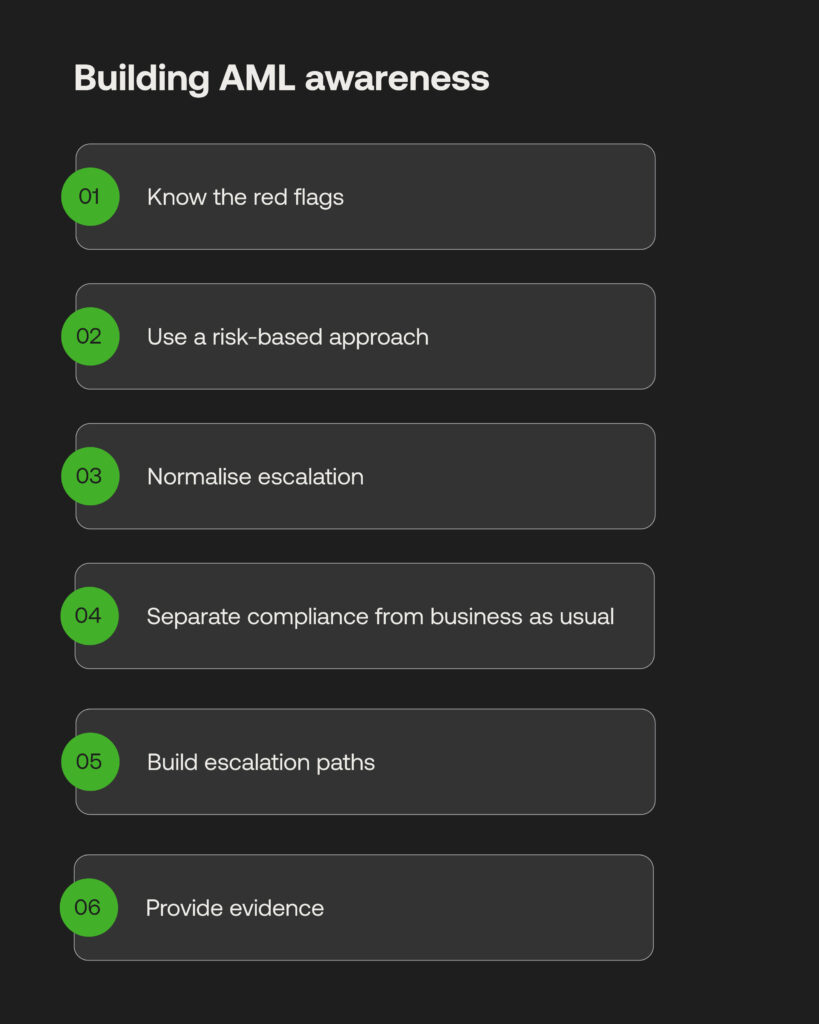
- Knowing the red flags: suspicious activity will differ per insurance role, where understanding common typologies and how to raise these movements with compliance leaders makes an employee a proactive risk deterrent.
- Applying ‘approaches’: the FIC’s recommended risk-based application of AML is proportionate to these industry-specific risks – not an ideal checklist, but a demonstrable process showing that aspirational compliance has been considered and managed accordingly.
- Treating escalation as common practice: FICA protects anyone who reports in good faith from criminal or civil action.
- Separating compliance from business as usual: completing onboarding for a firm is not the same as auditing a customer’s risk profile, where original role-based processes still apply (often without compliance caveats).
- Building escalation paths: mapping an obvious workflow from employees to the designated MLRO helps quickly address any detected risk, or any queries employees have around particular AML cases.
- Providing evidence: documenting all decisions where risk-based thinking is applied helps demonstrate accountability for any reports made to the FIC.
AML accountability in insurance ‘done right’
What this illustrates is that underwriters, distributors, and designers do not need to morph into a fully-fledged Money Laundering Reporting Officer (MLRO). They simply need to understand where spotting the right risk signals at the right AML stage assists the insurer’s entire compliance effort.
In practical terms, insurance firms that act accordingly are embedding AML thinking into workflows for all teams, essentially creating tailored prompts for risk detection across the firm’s processes. Then, administering AML training to each function – applicable to their day-to-day role that is neither generic nor in line with the AML work of other departments.
A third aspect of continuous KYC/AML involves RegTech. Automated platforms offer the ability to surface suspicious activity along a client funnel, supporting underwriting decisions or risk management in product pricing models. This provides audited paths of human-made decisions and proves AML accountability from every role at an insurer to a regulatory supervisor.
Getting ahead of AML accountability rules
Today, gaining a reasonable understanding of what AML is and why it assists even non-compliance functions at an insurance company is a strong starting point for building a formidable, RegTech-assisted defence against laundering and fraud risk.
Ultimately, it does not entail making compliance departments more stretched, as the talent and risk-averse nature of work exist across many insurance roles.
And just as greater compliance education and idea-sharing are needed for an institution to work effectively, that same idea, being applied outwards to interconnected intelligence units, financial companies, law enforcement, and government, works wonders for proactive anti-financial crime commitment.
That builds an individual and collective culture of continuous AML awareness, establishes processes in line with regulations, and stabilises defences against criminals who may erroneously see insurers as easy targets.
If you would like to see how risk-based onboarding, monitoring, and reporting tools work for role-specific functions in the insurance industry, feel free to reach out to RelyComply support.