Casino money laundering: The rising threat of crypto and online gambling
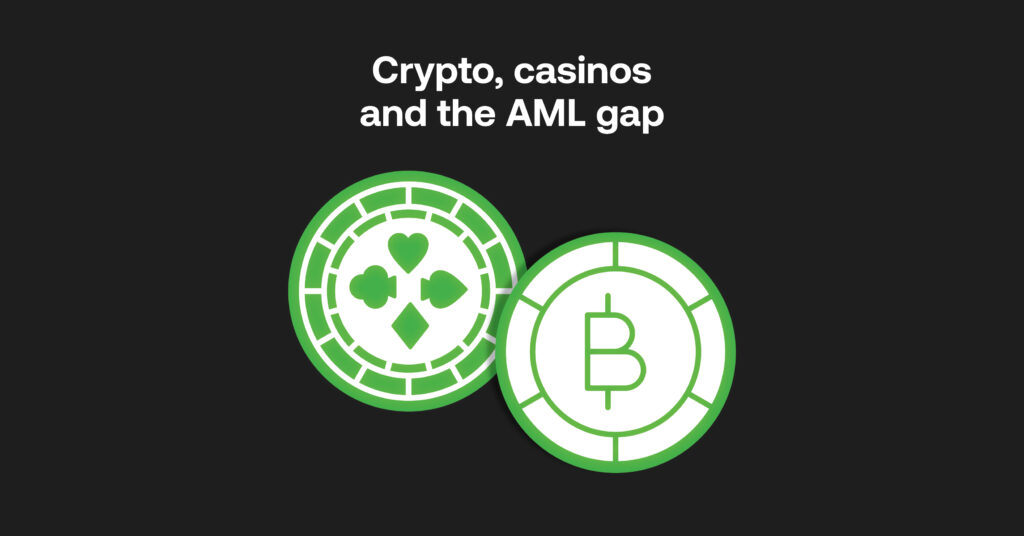
Financial criminality is often undertaken to ‘get rich quick’. This is the shared allure of gambling for many: an industry that offers criminals multiple avenues to work undetected.
In the traditional sense, casino money laundering may not even involve sophisticated measures, and instead rely on the simple spending of smaller, ‘smurfed’ dirty funds in any normal fashion. But now, gamblers no longer need to access brick-and-mortar casinos, as online gambling opportunities retain their anonymity.
Also playing into their hands is the South African public’s strong appetite for online gaming (covering sports betting or casino games), where illegal websites are prevalent. Around 30% of the population have in fact accessed such sites, ripe for cryptocurrency and digital asset-related risks monitored by the Financial Intelligence Centre (FIC) in line with legitimate casinos, fintechs, neobanks and payments platforms.
For proactive fincrime prevention, however, it takes a concerted cooperative AML effort between each instrumental player in the gambling industry to retain the safety of casino-based activity, and save the growing market from severe reputational damage.
Table of Contents
Casino money laundering and its troubling history
Casinos worldwide are often cast in shadow by Hollywood renditions of gangster-owned enterprises, which are not completely true. In South Africa, licensed and regulated gambling is perfectly legal and regular practice, where casinos and law enforcement are both tasked with battling opportunistic criminals that target casinos – ideal cash-heavy entities covers for them to unload their illicit proceeds.
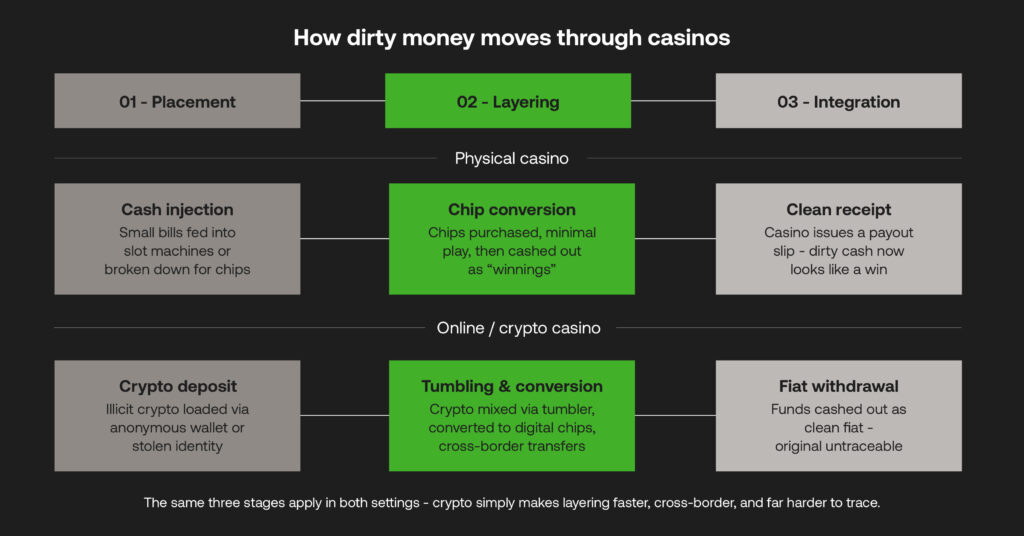
Dirty funds get introduced through casinos through increased spending: small injections into slot machines, or large bills broken down for table bets and purchasing chips that ‘sanitise’ the original monies. These simple methods are classic examples of FATF’s highlighted money laundering methods of placement (introducing funds), layering (obscuring funds from their source), and integration (turning dirty cash to legitimate assets).
The same concept works within online gambling. Only, digital payments and crypto wallets are utilised to greater effect as default options, which can obscure transactions. Online casinos that offer games including slots, poker, or roulette are illegal still under the National Gambling Act of 2004 (not including online betting), which goes some way to explain the proliferation of South Africa’s illegal sites.
Unfortunately, gambling addiction drives desperate users to around 2,000 illegal offshore gambling operators, and can also make them unwitting victims of identity fraud and blackmail, or ‘tipping’ scams committed through emotional manipulation and coercion.
Digital payments: The new AML frontier
Traditional criminal typologies will continue despite the new avenues available to them, and all add to the AML compliance complexity faced by accountable banks and payment providers that work alongside casinos.
Where crypto casinos are legal entities, that market seems to be overwhelming many licensed casino brands, with an estimated value between $10 and 11 billion. Examples such as Stake advertise strongly through TikTok and streaming services via popular social media influencers.
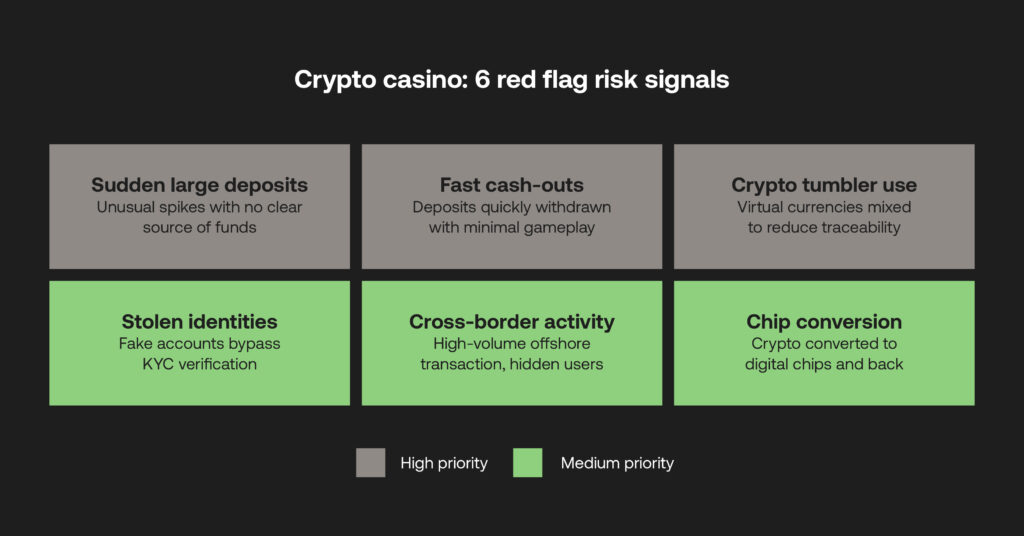
Cryptoassets can make identifying customer details and source of funds at the KYC stage very difficult, similar problems persist when identifying e-wallet owners. On top of this, the sheer volume of crypto casino sites and users based across borders hides identities and inter-account transactional activity indicative of laundering – such as sudden deposits, utilising digital chips to convert crypto or fiat proceeds, and fast cash-outs. Crypto tumblers offer more chances for virtual currencies to mix with viable funds and become less traceable, too.
Poor AML processes essentially means that high-risk payments and players can bypass integral identity verification (IDV) checks. Small-time criminals may simply avoid giving over compromising personal information, but professional criminal networks can utilise stolen identities to flush money through other account holders to remain anonymous. Even advanced biometrics can fall foul of such sophisticated crime, which requires real-time liveness checks to authorise users at the account onboarding stage and beyond.
Growing AML expectations
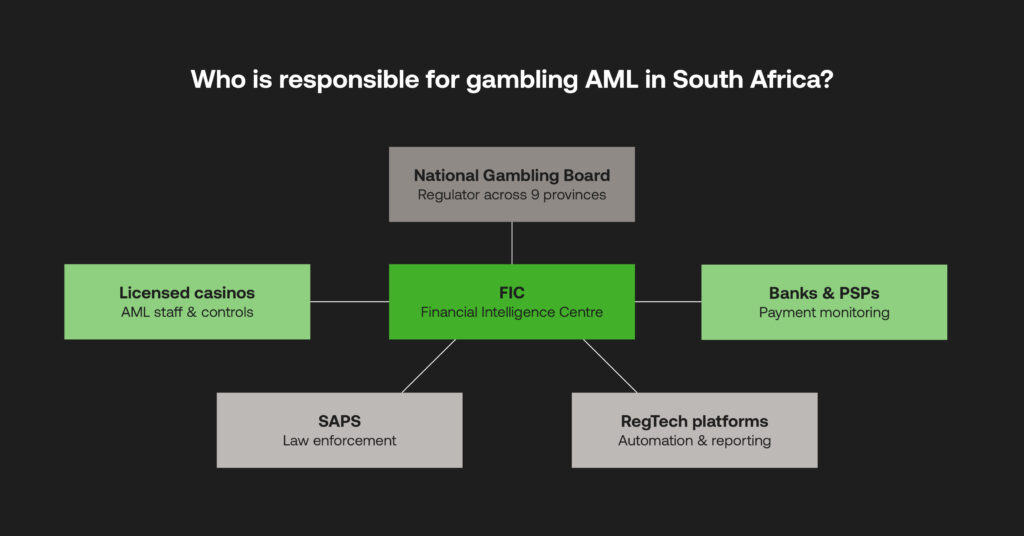
Gambling statutes in South Africa are nuanced between nine provinces, and tough for the National Gambling Board to regulate sufficiently. Likewise, SABRIC restrictions on access to illegal gambling sites have been discussed, but not enacted.
Luckily, the persisting problem is being recognised. Regulatory grey areas for crypto are identified by the FIC as high-alert sector-specific risks, while the regulator stresses the need for advanced KYC/AML controls that have been widely implemented by casinos. Their requirements are identical to payment firms and financial institutions: strengthened onboarding through IDV, watchlist screening and due diligence, and real-time transaction monitoring to raise and report suspicious payment patterns to the FIC, to then be dealt with by law enforcement.
Standardised compliance frameworks are essential to carving a more consolidated and multi-party approach to identifying wrongdoers and prosecuting them, facilitated by an end-to-end AML approach offered by regulatory technology (RegTech) platforms to assist the following:
- Documenting AML procedures and educating staff around typical illegal gambling red flags, to train employees to identify typical risk typologies.
- Conducting a risk assessment process that identifies any areas of AML vulnerability, from the KYC stage through to transaction monitoring and reporting.
- Undertaking advanced KYC/Know Your Vendor procedures to mitigate gaps in opened accounts, updating customer information, and using biometric IDV authentications for new customers.
- Implementing risk-based controls to screen any high-risk entities, jurisdictions, organisations and industries for enhanced due diligence measures.
- Enabling user-set thresholds for certain transaction amounts, or unusual payment patterns, for the continuous real-time detection of suspicious transactional movements.
- Automating the tracking of money trails to report audited data directly to the FIC using detailed, contextual suspicious transaction reports (SAR), bolstering financial crime investigations.
Such proactive use of financial intelligence underlines a strong AML mission that must be undertaken by casinos, regulators, government bodies, police, and third party banks, payment service providers, and clearance houses. Without it, digitally-enhanced crime networks and predatory fraudsters will continue to influence an industry tasked with keeping their players safe.
Maintaining forward-facing flexibility
Crypto regulation will continue to be stringent. So too will be the AML grip on ‘offline’ gambling and betting operators, with the spotlight on potentially fraudulent, unlicensed online sites. While those changes are ongoing, casinos and financial institutions in South Africa have a duty to get ahead: identifying the real risks of crypto-related laundering typologies, and partnering with solutions that are flexible to regulatory and criminal shifts.
Tackling synthetic identities and gambling fraud is part-and-parcel with detecting the proceeds of illegality (through fiat and crypto assets); an end-to-end AML process must account for every stage for every accountable firm and create a reliable, efficient and FIC-compliant network that allows popular and legitimate gambling to take place, without the fear of nefarious exploitation.