Beyond the fine: The true cost of AML compliance failure in South Africa
Regulatory heat is intensifying, shown up by striking ‘big number’ AML fine headlines. The damage of a multi-million dollar penalty makes for hard reading. Of course, it’s far tougher in practice for the suffering institution.
As South African businesses will know, no “accountable institution” is immune to the gaze of strict local and global AML legislation. In recent years, this has included a R250,000 fine to an offending business trust, up to damning amounts for reputable firms such as Old Mutual and HSBC – R15.9 million and R9.5 billion respectively for compliance failures.
Worse still, that fiscal burden is only the beginning of a long road to post-mortem recovery. The whole ordeal puts into perspective how costly non-compliance is; often far outweighing pre-fine investments into actionable anti-fincrime tools.
Here are the all-important repercussions that poor AML controls can lead to (lasting up to 36 months in severe cases), showcasing why upfront risk management is paramount.
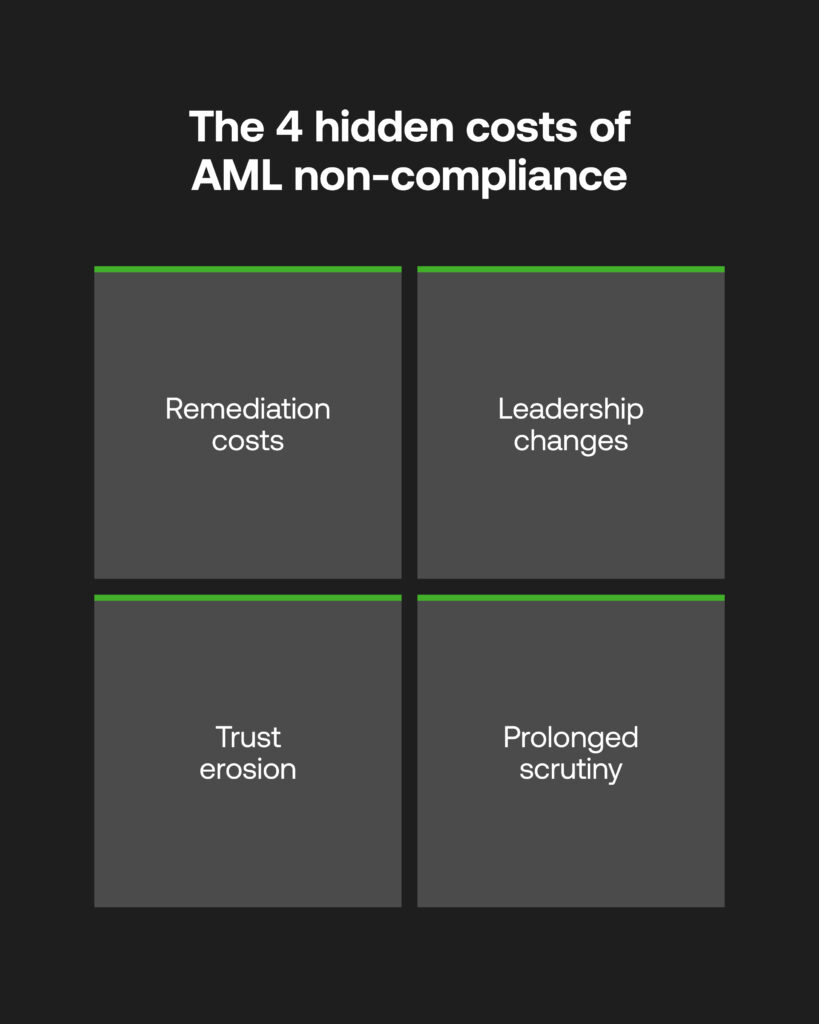
1. Obligatory remediation bills
The immediate impact of a slapped-on fine is a tough pill to swallow. However, the necessary remediation plans that follow dwarf that initial penalty.
The sheer number of outstanding remediations required for failed compliance in South Africa showcases the institutional extent of the problem. And this remediation is the only way to ‘atone’ to both regulators and customers, incurring vast unforeseen payments in a similar way to a poorly planned house build project.
However, seven-figure fixes seem less surprising considering what these costs go towards:
- Policy changes: alongside fiscal damage, time lost to manual reviews, transaction re-screening or suspicious activity report (SAR) checks and refiling can be huge. This diverts compliance team time from generating ROI, which could drastically make up for any regulatory fine shortfall.
- Hiring professional personnel: in many cases, internal or external consultants, legal firms, regulatory supervisors, and third-party auditors will be required to perform gap analysis, policy revisions, and tests for upgraded AML systems.
- Tech overhauls: as manual operations contribute to faulty KYC, transaction monitoring, screening, and reporting, switching to quick-fix automation platforms can lead to current system downtime and complex integrations.
2. The impact on senior leadership, downward
The human aspect involved in reforming an AML framework is mightily crucial, and so too can poor anti-fincrime measures affect the very makeup of a firm. An affirmed compliance culture comes from the top-down to influence every part of a business. Regulatory failures reflect on the institution’s need to change, or where shifting governance forces replacements at board level.
Accountability frameworks for senior management change per country, too. The US places “particular emphasis” on managing enforcement risk, and the UK’s Senior Managers and Certification Regime (SMCR) spotlights individuals responsible for adequate risk management protocols in their organisation.
The post-fine period can also put long-running internal dilemmas under the microscope, such as whether poor AML is a systemic failure, or if it can be pinned to a few figures. In more serious cases in South Africa where criminal intent is found, executives or employees found to be personally liable can face prison time on top of fines up to R100 million, according to FICA rules.
Nonetheless, even voluntary personnel changes – particularly high-profile or experienced roles such as Chief Compliance Officers, Money Laundering Reporting Officers (MLROs), and directors – lead to costly and lengthy recruitment drives. This consistent churn can disrupt any institution-wide compliance reform already underway, and stall or redo past effort.
3. Fixing global trust erosion
Some repercussions are less obvious than tangible invoiced penalties. For one, the trustworthiness of a firm can suffer following cases of wrongdoing, in the eyes of national and international consumers, investors, and regulators.
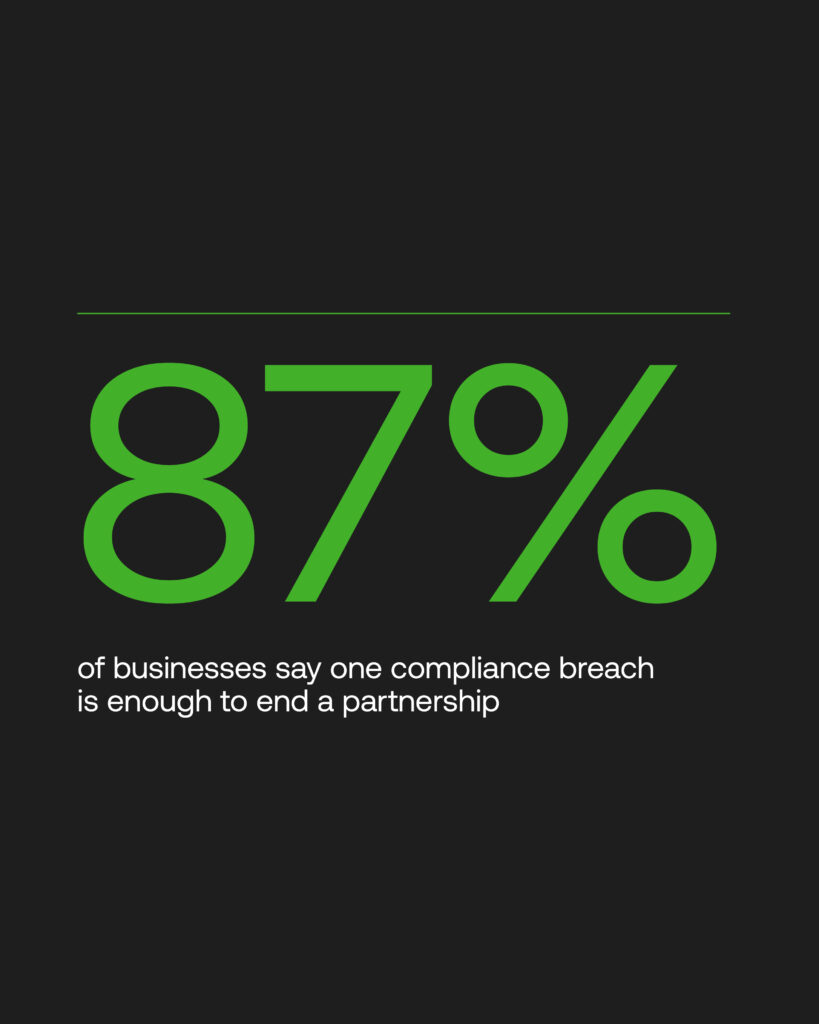
Ultimately, poor media coverage can taint reputations for years to come, especially in industry-specific trade magazines or national newspapers. It only takes one single compliance breach to wreck a partnership, according to 87% of businesses.
Particularly long-running AML faults often make global industry news (including FCA activity in South Africa here). In a world becoming smaller and more interconnected, where investment firms or correspondent banks often collaborate abroad, that trust erosion can see those relationships frayed, or ultimately terminated.
This reflects poorly on a nation’s risk frameworks on a global scale. South Africa is well aware of this, given its FATF greylisting 2023-25, where it took until January 2026 for the EU and UK to pull the jurisdiction from its high-risk third-country risk lists. Corporate or institutional investors will look to risk exposure as part of their allocation process, where scrupulous, compliant-first businesses will stand out as more attractive propositions.
Unsurprisingly, Deloitte found that a further 87% of executives believe reputational risk is more important than other strategic risks, considering its negative effect on market volatility and customer defection. When retail and business customers are forced to reassess their relationship to a financial institution, this can be a ‘quiet killer’: poor compliance leads to customer attrition and diminishes the ability to acquire new ones, particularly during unavoidable onboarding freezes.
This is an especially precarious position for early-stage startups looking for market entry, halting the dream of business growth before it has even begun.
4. Living under prolonged scrutiny
Sometimes, the Financial Sector Conduct Authority (FSCA) suspends a portion of its fines on the condition that the institution instils successful remediation and demonstrates more robust AML. For Sanlam in 2025, this saw R3.6 million being upheld for two years.
Still, being under a consent order or remediation effort can usually take between one and three years. The initial tag as an AML risk is a burden that only becomes stronger over time, and the budgets (and even mindset) to course-correct become less attainable.
The harsh fact is that remediation programmes, reputational rebuilding, digital overhauls, cultural mindset shifts and the day-to-day ‘business as usual’ KPIs must continue in tandem. Within this sits continuous monitoring and reporting to the FIC, where fear-based hyper-cautiousness can inadvertently lead to over-filed SARs or a comfort in continuing existing workflows – stalling innovations achieved through new product launches, M&A activity, and global expansion.
Achieving ROI upfront: a RegTech-forward future
Clearly, doing nothing to avoid AML scrutiny can be a retrospective disaster. A regulatory fine has traditionally been treated as a ‘slap on the wrist’ – but the remediation commitments that follow tell a different story: they stall growth, drain resources, and force institutions to reckon with just how central AML must be to sustainable operations.
Instead, a sound compliance infrastructure – standardised frameworks, RegTech platform integrations and supportive relationships, good data governance, and well-trained staff – all sets an accountable institution up with what it needs to avoid a R10 million penalty, or indeed the five-fold increase that could follow.
Meeting stringent regulators at their level is what makes for a resilient and proactive institution, flexible to a future where customer experiences and compliance demands will always be rising. RegTech-facilitated AML is an operational feat, but more importantly, an advantageous tool to boost reputations in a highly competitive financial space.